
 HOME

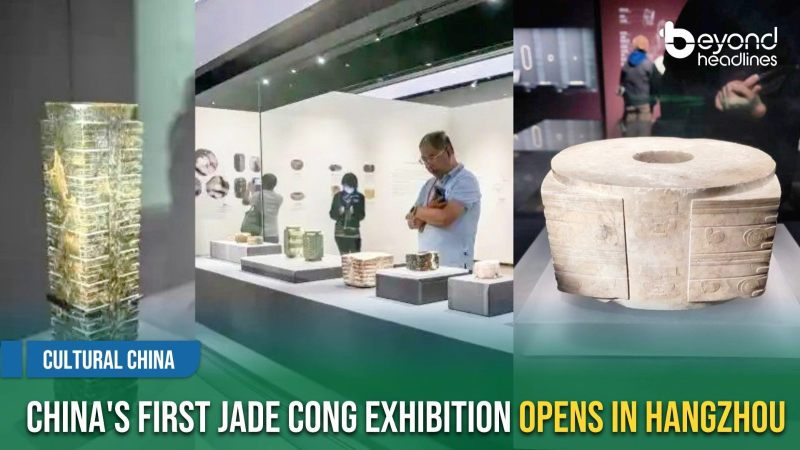


The Liangzhu Museum in Hangzhou, Zhejiang, is hosting China's first major exhibition devoted to the jade cong, drawing record crowds. A tubular ritual jade of ancient China, the cong served primarily in sacrificial rites and stood as a symbol of power and faith. The oldest known example dates back some 5,100 years, while the greatest concentration of unearthed cong comes from the Neolithic Liangzhu Culture sites centered on Hangzhou.
The exhibition assembles 124 cong and cong-style objects spanning 5,000 years, drawn from 39 institutions across 14 provinces and overseas collections. It traces the cong's transformation from a prehistoric emblem of divine authority to a state ritual vessel of the Xia, Shang, and Zhou dynasties, and onward to a literati object of refined appreciation in the Song, Yuan, Ming, and Qing eras.
The 'King of Jade Cong,' bearing eight complete sets of deity-and-beast masks carved within the straight grooves on its four sides, is the largest and most exquisitely wrought Liangzhu cong ever found. It was on this very artifact that archaeologists first identified the complete, finely incised deity-and-beast motif—its lines so delicate that five or six fit within a single millimeter—representing the zenith of Liangzhu jade craftsmanship 5,000 years ago.
Each cong tells its own story of civilizational exchange and reinvention. Visitors marvel at the extraordinary aesthetic sensibility of the ancients, calling the exhibition a comprehensive history of Eastern aesthetics written in jade.