
 HOME

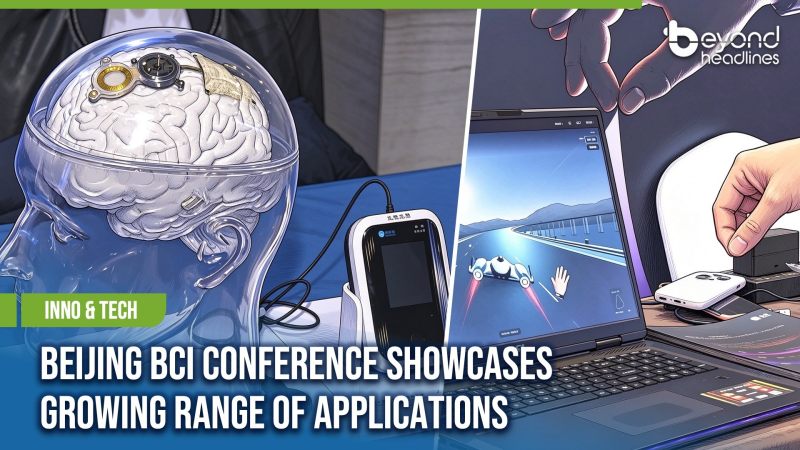


A brain-computer interface (BCI) conference in Beijing has highlighted the technology's expanding range of applications, spanning medical rehabilitation, industrial safety and everyday human-machine interaction.
The 2026 Brain-Computer Interface Conference, hosted by the China Academy of Information and Communications Technology (CAICT) from November 19 to 22, showcased the latest developments in both invasive and non-invasive BCI systems.
Among the exhibits was an implanted system that decodes brain signals to help people with spinal cord injuries or stroke-related disabilities regain motor functions through rehabilitation training. Its flexible electrodes, less than six microns thick, have already been used in 44 human implantations.
BCI technology is also finding applications beyond healthcare. Smart hard hats fitted with brainwave-monitoring modules are being deployed in industries including construction, mining and power generation to monitor workers' fatigue and attention levels.
Other innovations included wrist-worn devices that translate neural signals into hand gestures, and a compact, three-gram EEG system designed for everyday use, with potential applications in sleep monitoring, exercise and education.