

 HOME

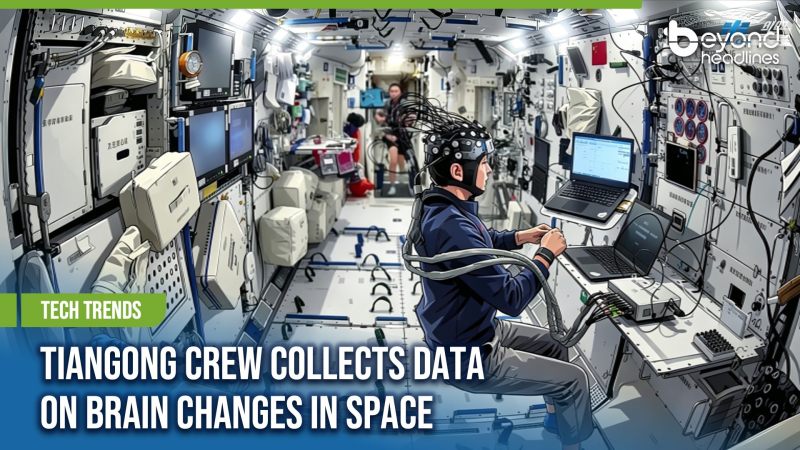


Astronauts aboard China's Tiangong Space Station have conducted a series of brain monitoring experiments to help researchers understand how long-term spaceflight affects human brain function and sensory perception.
The Shenzhou-23 crew used electroencephalogram (EEG) equipment to monitor brain activity, focusing on brain network mapping and visual motion processing.
The astronauts also carried out tests on the time-varying characteristics of brain networks, tactile perception and force control. Data collected from the experiments will help scientists study changes in astronauts' brain functional networks, sensory responses and fine motor control during extended stays in orbit.
The findings could provide valuable insights into how the human brain adapts to the microgravity environment, supporting research into astronaut health and the challenges of long-duration space missions.